1.Installation and expansion of Divertor plasma facing components in ADITYA-U
To enable shaped-plasma operation in divertor configuration, graphite plasma-facing divertor tiles were designed, fabricated, conditioned and installed in Aditya-U. Following phased implementation, divertor coverage was increased from about 30% to nearly 75% using 104 graphite tiles integrated with in-vessel diagnostics and safety structures. The tiles underwent ultrasonic cleaning and high-temperature vacuum baking prior to installation. One divertor tile incorporates flush-mounted Langmuir probes for divertor plasma studies. The upgraded divertor configuration provides an important platform for investigating plasma exhaust, plasma-wall interactions and shaped-plasma operation in Aditya-U.
2.Deuterium Plasma Operation in ADITYA-U
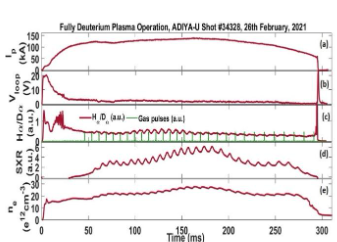
ADITYA-U successfully established stable pure deuterium plasma discharges, marking a significant milestone in India's magnetic confinement fusion programme. Deuterium plasmas were produced using both pre-fill and gas-puff fueling at a toroidal magnetic field of ~1.28 T, achieving plasma currents of 140–150 kA, chord-averaged electron densities of 3–3.5 × 10¹⁹ m⁻³, and discharge durations of 300–350 ms. Neutron monitoring confirmed safe operation within prescribed limits. Comparative studies demonstrated approximately twofold improvement in energy confinement compared with hydrogen plasmas, providing valuable insights into isotope effects relevant to future fusion devices.
3.Global Energy Confinement TimeE and Isotope Scaling Studies
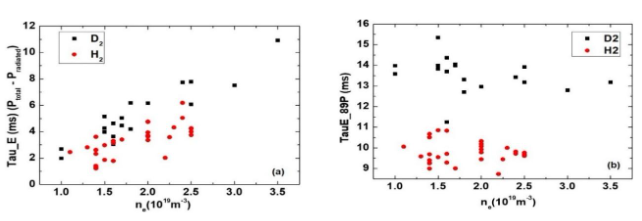
ADITYA-U investigated the dependence of global energy confinement time E on plasma density and isotope mass by comparing hydrogen and deuterium discharges under similar operating conditions. The study demonstrated improved confinement in deuterium plasmas, consistent with the isotope scaling relation E∝ M (ξ > 0). Maximum experimental E values of ~6.5 ms for H₂ and ~11 ms for D₂ plasmas were obtained. Measured confinement times showed good agreement with neo-Alcator and ITER-89P scaling predictions, providing validation of confinement scaling laws and valuable input for future reactor design studies.
4.Initial Shaped Plasma Operation in Open Divertor Configuration
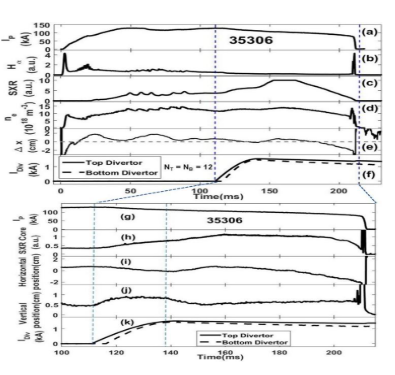
ADITYA-U achieved its first shaped-plasma operation by independently energizing the upper and lower divertor coils during hydrogen and deuterium discharges. Current pulses of 36–60 kA-turn applied to the divertor coils modified the plasma geometry, producing controlled radial and vertical shifts of the plasma column. Shaped-plasma operation resulted in reduced Hα and C-III impurity emissions, increased line-averaged electron density and soft X-ray intensity, and improved discharge duration and stability. Equilibrium reconstruction using the IPREQ code confirmed the plasma shaping effect, marking an important step toward advanced divertor-based plasma operation in ADITYA-U.
5.Disruption Mitigation Studies Using Electromagnetically Driven Pellet Injection (EPI)
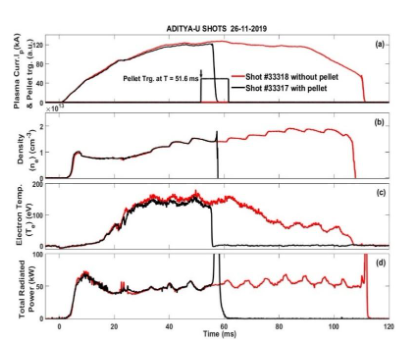
ADITYA-U carried out its first disruption mitigation experiments using an electromagnetically driven pellet injector. Lithium titanate (Li₂TiO₃) impurity pellets were injected during the plasma current flat-top (IP ≈ 120 kA), reaching the plasma core within ~1.25 ms and triggering rapid radiative termination of the discharge. Spectroscopic measurements confirmed pellet penetration and deposition, while density, temperature, and plasma current decreased rapidly due to enhanced radiation losses. Fast visible imaging showed disruption of the plasma column within <2 ms. Comparative studies revealed faster current quench dynamics for pellet-triggered disruptions than for massive gas injection, providing valuable data for disruption mitigation strategies in future devices such as ITER.