
Open House Help Desk Public Grievances IPR Act and Rule
Opportunities Annual Reports Tender Dashboard

Blanket Design and Fusion Fuel Cycle

Blanket Design and Fusion Fuel Cycle
Overview

The Blanket Design and Fusion Fuel Cycle BDFC Section is entrusted with carrying out indigenous research and development activities on nuclear design & optimization, outer fusion fuel cycle for their application in the Breeding Blanket System of nuclear fusion reactors. The relevant R&D activities to develop technologies associated with hydrogen isotope extraction, removal, recovery, purification, safe storage and analytics of hydrogen isotope related ancillary systems of the fusion blanket are being actively pursued at IPR.

Major Research & Development Activities: Research and development activities undertaken by BDFC section are as follows:

• Nuclear Design and Optimization of Breeding Blanket of Indian fusion reactors.

• Nuclear Design, Activation Analyses, Radiation Damage, Dose Rate and Rad-Waste assessment of Test Blanket Module System in ITER

• Technology development for Q2O and Q2 processing in Helium Gas and Q2 storage (Lab Scale Level):

◦ Atmospheric Molecular Sieve Bed (AMSB), Reduced Metal Bed (RMB),

◦ Cryogenic Molecular Sieve Bed (CMSB)

◦ Hot Metal Bed (HMB), Getter Bed

• Development of Coating technology: Dip coating, Magnetron sputtering

• Hydrogen isotope permeation experiments: structural material

• Development of Hydrogen Isotope Extraction System (HIES) for liquid PbLi.

• Multi-scale modelling of adsorption/absorption process for AMSB, CMSB, getter beds; development of numerical model to study hydrogen isotopes permeation through structural materials; Hydrogen isotope release modelling from lithium ceramics.

• Design of Integrated loop for hydrogen isotope removal & recovery from He purge gas and storage system.

• Tritium residence time and inventory assessment in solid breeder blanket and dynamic tritium inventory analyse in outer fuel cycle components of fusion reactor.
Blanket Design and Fusion Fuel Cycle
Activities

1.Development and Testing of Lab-Scale Atmospheric Molecular Sieve Bed

A lab-scale AMSB is designed and developed using Zeolites 4A as an adsorbent material. Experimental breakthrough curves for the adsorption of various concentrations of moisture (up to ~20,000 ppm) at different flow rates (1-3 LPM) from helium gas at room temperature have been generated. Parametric analysis of the generated breakthrough curves and effect and proper way of regeneration of saturated lab scale AMSB bed to maximizing its adsorption capacity have been studied in detail. Theoretical breakthrough curve is obtained by RT Yang model of Zeolites and found to be in reasonably good match with experimental data.


2.Development and Testing Lab Scale Mg based Reduce Metal Bed (RMB) for Fuel Cycle Application

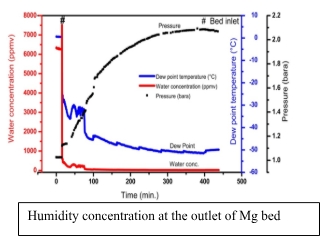
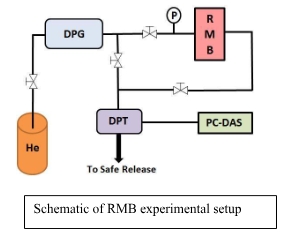
A lab-scale Reduced Metal Bed (RMB) system is designed and developed to convert ppm-level water vapour in helium into hydrogen using magnesium powder as the reactive medium. Initial experiments with ~180 µm magnesium powder achieved 14–20% conversion for water vapour concentrations up to ~6000 ppm at different operating conditions. Significant enhancement in performance (>99.5% conversion) is observed using ball-milled magnesium powder (~4 µm), highlighting the importance of particle size. X-ray diffraction analysis supports the reaction mechanism. Additionally, the influence of upstream side pressure buildup on downstream dew point is systematically evaluated.


3.Development of lab-scale Cryogenic Molecular Sieve Bed (CMSB) System for Q2 removal from Helium

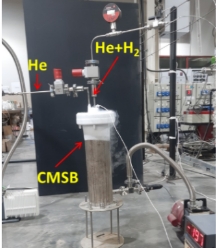
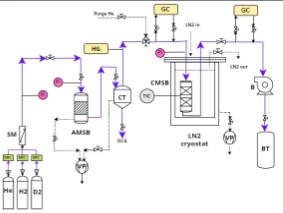
Cryogenic Molecular Sieve Bed (CMSB) is the one of the most critical component of FFC. The primary objective of CMSB is to remove trace level and recover higher concentrations of hydrogen isotopologues from helium gas. To demonstrate the operation of CMSB, a lab-scale cryogenic adsorption system has been developed to study the separation of trace levels (100 - 1000 ppm) of hydrogen isotopes (H2, D2) from helium at 77.4 K. The experimental binary breakthrough curves indicated competitive adsorption phenomena due to quantum sieving effects. Breakthrough experiments and validated numerical models provide key data on adsorption capacities, isotope selectivities and scale-up design for CMSB of TERS, Coolant Purification System (CPS) and Tokomak Exhaust Processing (TEP).


4.Development of Gas Chromatography System for the Online Monitoring of Hydrogen Isotopes and Impurities in He gas

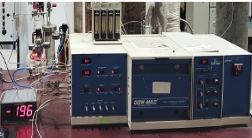
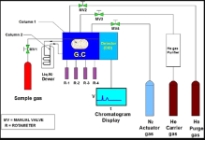
A gas chromatography (GC) setup has been established for the separation and analysis of hydrogen isotopes in helium, relevant to FFC studies. Gas chromatography offers a simple, cost-effective, and fast analytical alternative to conventional methods like mass spectrometry or RGA. The developed columns exhibited good resolution and separation effectiveness for trace levels of impurities as well as hydrogen isotopes in helium at 323 K and 77.4 K respectively. The methodology can be utilized for real-time analysis and rapid monitoring of trace level of hydrogen isotopologues in helium purge gas. It may also serve as a useful diagnostic tool for tritium accountancy and process control in the FFC systems.


5.Modeling/Simulations for Fuel Cycle Materials Research

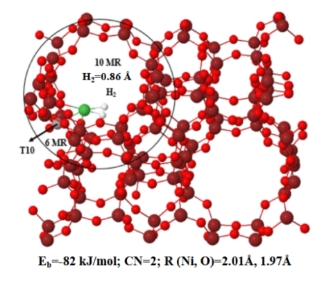
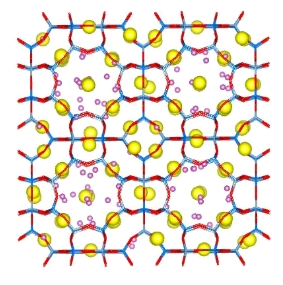
In fusion breeder zones, hydrogen is primarily released as HT. Due to the experimental constraints and scarceness posed by radioactive isotopologues such as HT, DT, and T2, computational methods are essential. Grand Canonical Monte Carlo (GCMC) simulations have been carried out to model the low-pressure adsorption isotherms of all hydrogen isotopologues on LTA zeolites at 77.4 K and 87.3 K. For long-term use in CMSB systems, adsorbents capable of reversible hydrogen isotope adsorption at near ambient conditions are required. Periodic DFT modeling studies were performed to evaluate the binding strength and feasibility of metal-functionalized ZSM-5 as a future CMSB adsorbent.

Division Head

Dr. Paritosh Chaudhuri

Dr. Paritosh Chaudhuri

Designation
:
SO-H
Phone
:

Section Head

Dr. Chandan Danani

Dr. Chandan Danani

Designation
:
Scientific Officer-G
Phone
:

Team Members

Rudrekshkumar Patel

Rudrekshkumar Patel

Designation
:
Scientific Officer - F
Phone
:
Dr. V. Gayathri Devi

Dr. V. Gayathri Devi

Designation
:
Scientific Officer-F
Phone
:
Dr. Pratipalsinh A Rayjada

Dr. Pratipalsinh A Rayjada

Designation
:
Scientific Officer-E
Phone
:
Sudhir Rai

Sudhir Rai

Designation
:
Scientific Officer-E
Phone
:
Deepak Yadav

Deepak Yadav

Designation
:
Scientific Officer-E
Phone
:
Mohit Gupta

Mohit Gupta

Designation
:
Scientific Assistant-B
Phone
:
Last Updated: 17-Jul-2026 03:45 PM