1.Signal Conditioning Electronics for Plasma Diagnostics
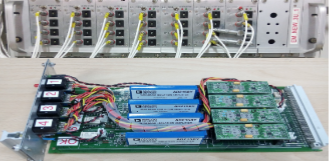
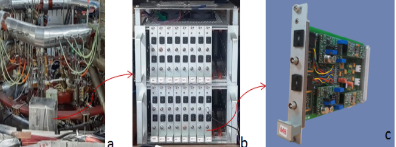
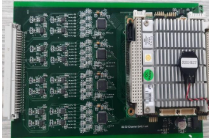
A range of signal conditioning electronics has been developed to interface with various plasma diagnostic sensors like AXUV diodes, photomultiplier tubes, magnetic probes and coils, and Langmuir probes, enabling precise measurement of multiple plasma parameters. Electronics are equipped with functionalities like isolation, remote control, analog differential transmission, attenuation/gain, filter, high voltage amplification and control, drift-free analog integration for real-time measurement of plasma parameters, and many others as per experimental requirements for Tokamak and basic plasma experiments.
At present, approximately 500–600 modular electronics boards, each performing distinct functionalities, are deployed and operational across the Institute, supporting comprehensive diagnostics and control of plasma experiments.
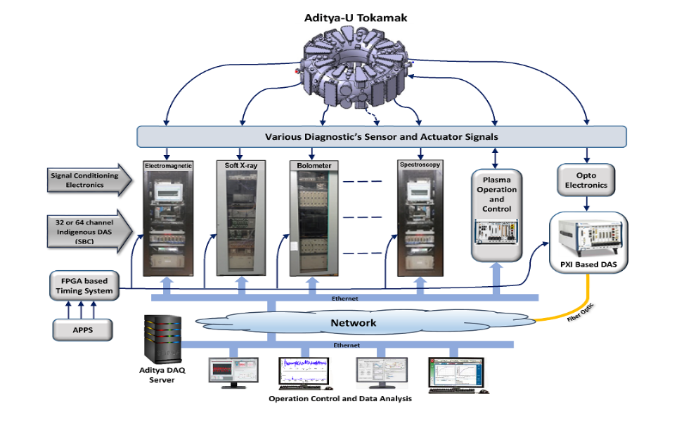
2.Indigenous Data Acquisition System for Plasma Diagnostics: SBC-32 and SBC-64
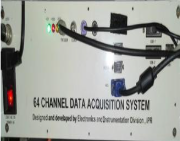
The Electronics and Instrumentation Division has indigenously developed a data acquisition system to capture data from various plasma diagnostics. Two versions of the system have been designed to meet specific experimental requirements: SBC-64, supporting 64 input channels, and SBC-32, supporting 32 input channels. The system is built around a single-board computer (SBC), making it fully standalone.
It is capable of processing acquired data internally and transferring archived data files to a central server via Ethernet, eliminating the need for an external PC. Seven such systems are actively employed for plasma diagnostics acquisition in the Aditya-U Tokamak, simultaneously acquiring diagnostic signals within the range of ±10 V at a sampling rate of 100 kHz, with 16-bit resolution on 4M × 16 SRAM memory.
3.System-on-Chip Based System for Magnet Diagnostics
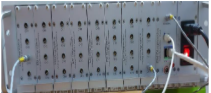
A System-on-Chip (SoC) based electronics and data acquisition system for magnetic probe diagnostics has been developed. A single 3U chassis consists of 32 channels of signal conditioning electronics with 5 kV common-mode voltage isolation in each channel. The chassis is also integrated with data acquisition and power supply modules. The DAQ unit is based on the AMD Zynq SoC with 1 GB DDR memory.
The system offers several useful features, including a programmable sampling rate of up to 500 kHz, programmable gain/attenuation, and an integrated programmable Direct Digital Synthesis (DDS) based signal generator for testing. The chassis also includes the capability to connect an external DAQ using a 32-channel fully differential driver module. The system is currently being used in the Aditya-U and Spherical Tokamak experiments.
4.Timing System for ADITYA-U Tokamak Machine Operation
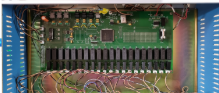
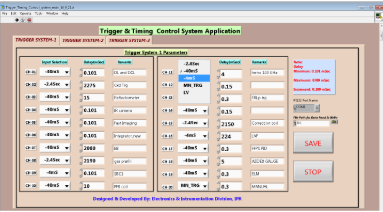
The timing system has been developed in-house to synchronize various subsystems required for plasma operation in the ADITYA-U Tokamak. The system, serially connected through RS232, receives optical triggers from the Toroidal Field Power Supply (TFPS) system at −2.4 s, −40 ms, and −4 ms for processing on the FPGA, which generates 52 TTL-isolated output pulses.
Users can select a delay of up to 6.7 seconds for each trigger before plasma discharge, with a resolution of 100 µs, through a graphical user interface (GUI). The system ensures precise synchronization of subsystems including the Gas Pre-Fill System, data acquisition system, radio-frequency pre-ionization and heating system, and plasma position control, all of which are essential for successful plasma operation.
5.Electronic Systems for Plasma Control for ADITYA-U Tokamak
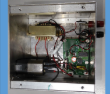
Electronic systems have been developed in-house and deployed for plasma operation and pulse control in ADITYA-U. The developed system includes a DSP-based real-time plasma position calculation system, a cRIO-based centralized PID controller, and a VFC-based fiber-optic communication link to interface with high-voltage power supplies.
The DSP circuit consists of a 32-bit TMS320F28335 controller with a floating-point engine, an on-board multi-channel 12-bit analog-to-digital converter (ADC), and a 12-bit SPI digital-to-analog converter (DAC). The DSP card operates at a processing throughput of 10 kHz. The cRIO platform implements a centralized PID controller to achieve stability and an appropriate settling time for feedback control. The typical control loop time in ADITYA-U is approximately 1 ms.
Other control circuit implementations include disruption control, gas-puffing control interlocks, and plasma current ramp-rate control. These systems have been successfully operated over multiple experimental campaigns and have played a crucial role in achieving stable, disruption-free, and elongated plasma discharges.
6.Automation of Baking System for ADITYA-U Tokamak
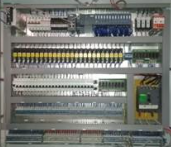
A Programmable Logic Controller (PLC)-based control system has been implemented for baking and conditioning the vacuum vessel of the ADITYA-U Tokamak. Approximately 50 heaters and 80 RTDs are installed throughout the vacuum vessel, pumping lines, and diagnostic systems for temperature monitoring and control. The heaters operate in a closed-loop configuration using an in-house developed control system based on Siemens PLC, SCADA, SSR, and electrical switching and protection systems.
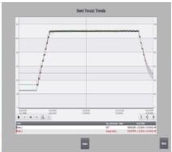
The baking process is carried out over a period of 48 hours. It begins with a controlled ramp-up from room temperature to a constant temperature of 150°C, followed by a gradual ramp-down. The various PLC modules (AI, AO, DI, and DO) are programmed using SIMATIC STEP 7 software, while the Supervisory Control and Data Acquisition (SCADA) system has been developed in LabVIEW.