1. HTS Solenoid Magnets
The design, fabrication, testing and performance validation for the high temperature superconducting (HTS) solenoid magnets of field ranging from 0.1 T to 3.5 T has been successfully demonstrated. The required technologies such as double pancake winding, joints, terminations, integration with current leads, integration with cryostat has been realized and demonstrated.
2. HTS Cables
The design, fabrication, testing and performance validation of stacked type HTS cables for the steady state operation of superconducting magnets has been realized. HTS cables capable of carrying current ranging from 1-8 kA @ 77 K, self-field has been successfully demonstrated.
3. D-shape HTS Magnet
A D-shaped HTS magnet, measuring 1.1 m in height and 0.7 m in width, has been successfully designed, fabricated and tested up to 1.2 kA at 77 K. This magnet consists of a vacuum-jacketed liquid nitrogen (LN₂) cryostat enclosing the REBCO HTS winding pack configured in a double pancake using stacked type HTS cable. The required technologies such as fabrication of long length HTS cable, winding in D shape, joints & termination with current leads and encasing of winding pack has been demonstrated.
4. Cryostat for Superconducting Magnet Test Facility
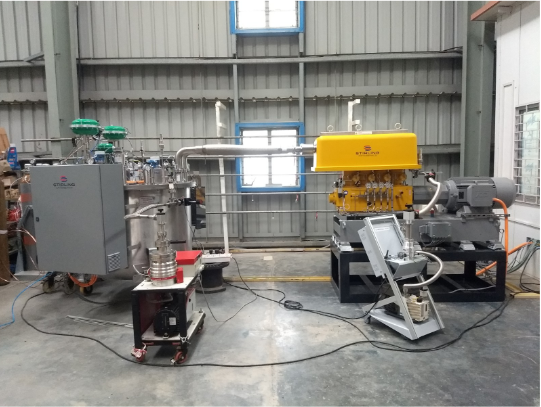
Large volume Cryostat (80 m³) with 80 K integrated thermal shield, LN2 cooling circuits and vacuum system was installed and commissioned under Test facility development for the superconducting magnets. The integrated cryostat was evacuated to the vacuum in the order of 10⁻⁵ mbar with controlled cool down of the thermal shield to 80 K using LN2.
5. Cryo-cooler Based Test Facility
A Pulse Tube Cryocooler (PTC) is a cryogenic refrigeration device used to achieve very low temperatures without any moving parts at the cold end. It operates based on the periodic compression and expansion of a working gas, typically helium, to produce cooling. Pulse tube Cryo-coolers are highly reliable, vibration-free, and require low maintenance, making them suitable for long-term cryogenic applications. This facility is utilized for the V-I characterization of superconducting wires, tapes, small-diameter magnets, and superconducting joints. It is also employed for the calibration of CCS and Cernox temperature sensors down to 4.2 K.
6. Warm Bore Cryostat
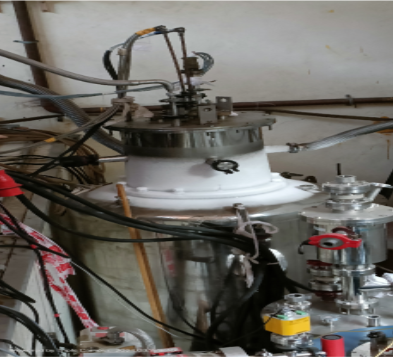
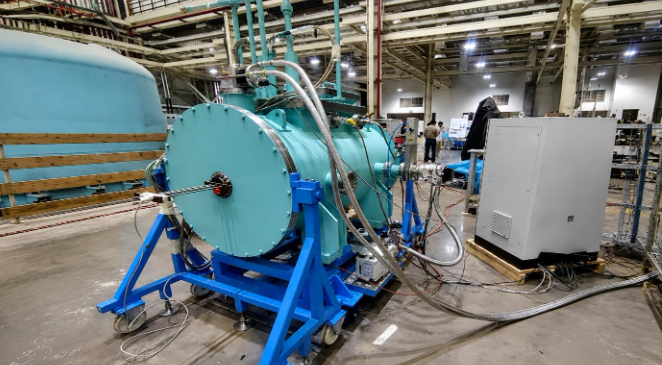
Warm Bore Cryostat (WBC) facility consists of the vacuum chamber, thermal shields, cryogenic chamber, and two stage Cryocooler, cryogenic interfaces, current leads and supports. The 3 T HTS coil is integrated in WBC and tested up to 90 A at 30 K using the Solid Nitrogen cooled by the cold head of the Cryocooler. WBC provides the room temperature bore of ~100 mm with background field generated by HTS coil.
7. Self-Field Test Facility
This facility is designed for the characterization of superconducting and non-superconducting materials under bath-cooled cryogenic conditions down to 4.2 K (liquid helium temperature). It enables the measurement of electrical, thermal, and magnetic properties of various samples at low temperatures. The facility can accommodate and test Cable-in-Conduit Conductors (CICC) up to approximately 350 mm in diameter and 500 mm in length, as well as superconducting wires and magnets under self-field conditions.
8. Cold Bore Vertical Cryostat
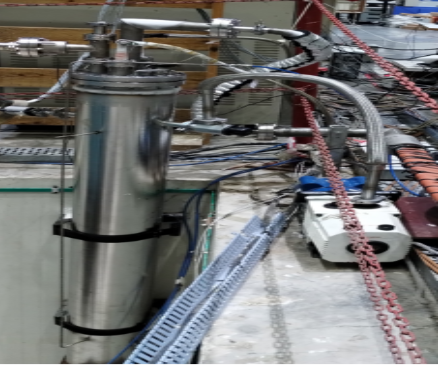
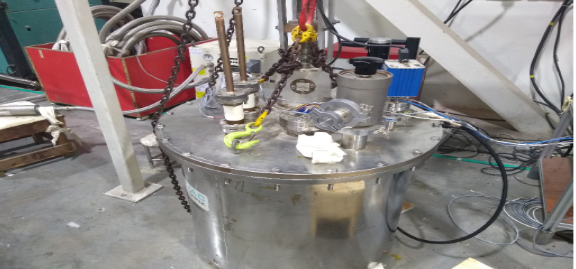
Cold Bore Vertical Cryostat (CBVC) is installed and commissioned to test the HTS magnet at varying cryogenic temperature (from 77 K to 55 K) under bath cooled condition. The maximum size of HTS magnet that can be accommodated is 500-100 mm (Height) and 300 mm (OD).
9. Solid Nitrogen Test Facility
The Solid Nitrogen Test Facility is used to test small High-Temperature Superconductor (HTS) samples at cryogenic temperatures of up to 50 K. It provides a stable and low-temperature environment using solid nitrogen, making it suitable for evaluating the performance of HTS materials. The facility has an inner diameter of 160 mm and a length of 1.8 meters, allowing accommodation of small test samples like HTS tape and magnet under controlled cryogenic conditions.
10. Cryocooler Based Helium Circulation System up to 55 K
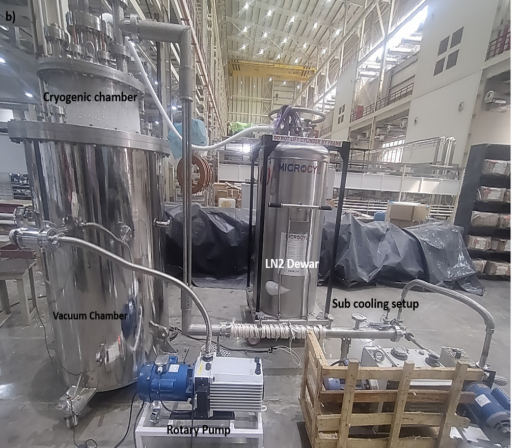
Cryocooler Based helium circulation system with cooling power of 600 W at 55 K is installed and commissioned for the HTS application. The circulation system provides cold helium at 55 K, ≥ 16 bar (a) at outlet with mass flow rate of ≥ 23 g/s. The system will run in a closed loop with fully automatic process operation with all modes (cool-down, warm up, test mode) for HTS applications.
11. Metallurgical Characterization Facilities
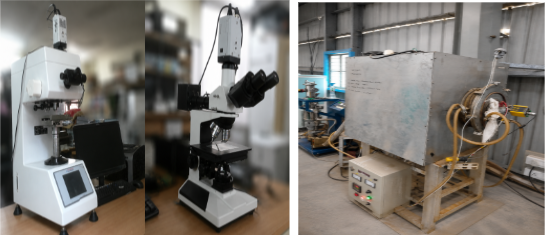
Metallurgical and Insulation Characterization facilities have advanced instruments for the comprehensive analysis and processing of superconducting and engineering materials. The metallurgical microscope, integrated with a high-resolution CCD camera and image analysis software, enables detailed microstructural examination, grain size measurement, and defect analysis at magnifications up to 1000X. The Vickers micro hardness tester provides precise hardness measurement in the load range of 1–1000 gm, essential for evaluating mechanical properties of fine different phases and coatings. Additionally, the lab-scale vacuum heat treatment furnace, capable of achieving high vacuum (~10⁻⁶ mbar) with precise PID temperature control, supports controlled annealing and heat treatment processes of Nb3Sn magnets.
12. Chemical Characterization Facilities
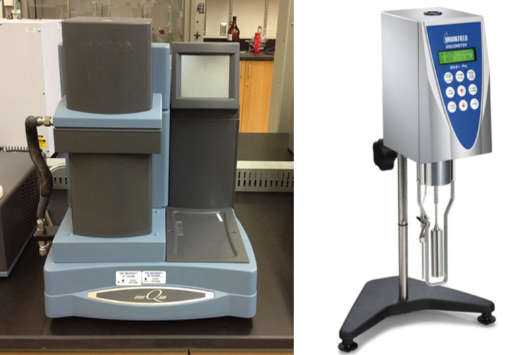
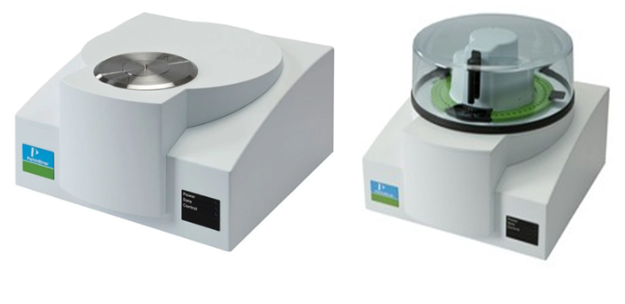
A thermal and rheological test facility equipped with Differential Scanning Calorimeter (DSC), Simultaneous Thermal Analyzer (STA), Dynamic Mechanical Analyzer (DMA), and a Viscometer provides comprehensive material characterization capabilities. DSC is used to study phase transitions, melting, and crystallization behavior. STA simultaneously measures weight change and heat flow, enabling thermal stability analysis. DMA evaluates the viscoelastic properties of materials under varying temperatures and frequencies. The viscometer measures fluid viscosity and flow behavior.
13. Winding Setups/Machine for HTS Magnets
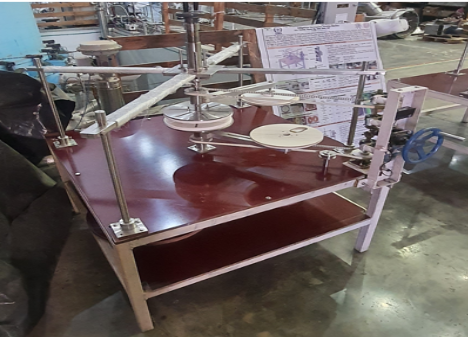
A double-pancake type winding machine has been developed for winding long-length HTS tapes of approximately 4.5 mm width and 0.14 mm thickness. It is designed to fabricate magnet coils with a minimum bore diameter of 50 mm and a maximum diameter of 250 mm.