1.Development of Pulsed Power Supply for High Density Plasma Application
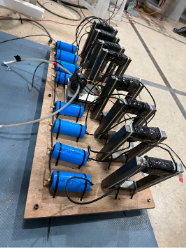
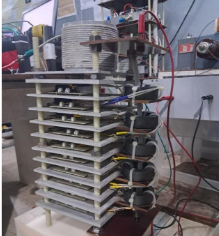
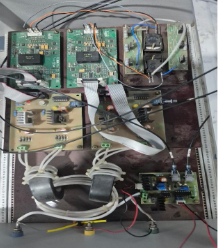
Design, simulation, and experimental realization of repetitive pulsed high-voltage power supplies have been carried out for high-density plasma generation and pulsed power applications. Multiple power supply topologies operating in the 0–5 kV range have been developed with pulse durations ranging from microseconds to milliseconds and peak current capability up to several hundred amperes. The work includes the development of Pulse Forming Networks (PFN), semiconductor and SCR-based switching assemblies, snubber protection circuits, triggering systems, and voltage equalization networks for reliable high-voltage operation.
Extensive circuit modelling and optimization have been performed using simulation tools such as PSIM, followed by experimental validation through hardware implementation. The developed systems are integrated with laboratory-scale plasma chambers for generating transient glow discharge plasma under varying operating conditions. These pulsed power platforms are being utilized for microwave–plasma interaction studies, electromagnetic attenuation experiments, and other high-voltage plasma applications requiring controlled and repeatable pulse operation.
2.Microwave Plasma Interaction Studies Using Pulsed Plasma
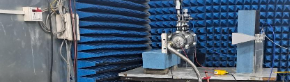
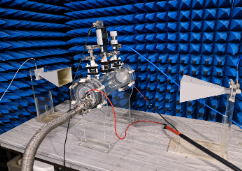
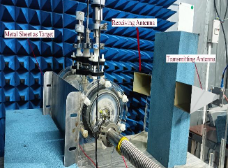
A laboratory-scale pulsed plasma system was developed to investigate electromagnetic wave interaction with transient glow discharge plasma. The setup employed a 0–5 kV pulsed excitation source with millisecond-scale pulse duration for generating stable high-density plasma. Microwave transmission and reflection measurements were carried out in the X-band frequency range using calibrated RF diagnostics and horn antenna configurations.
Experimental observations showed strong modulation and attenuation of microwave signals, with absorption efficiencies approaching 90% in the 10–12 GHz band. The study also highlighted plasma afterglow behavior and its role in sustained electromagnetic attenuation after pulse termination.
3.Development of High-Voltage Switching Systems
Research activities were carried out toward the development of high-voltage switching systems and current-handling assemblies for pulsed power and high-voltage applications. The work involved the design and implementation of semiconductor-based switching configurations, protection circuits, snubber networks, triggering systems, and voltage equalization techniques for reliable operation under high-voltage and high-current conditions.
Emphasis was placed on improving switching reliability, transient protection, and pulse delivery performance for repetitive pulsed power applications. The developed switching systems support plasma generation experiments and other laboratory-scale high-voltage systems requiring controlled pulse operation.
4.Anechoic Chamber Facility for RF and Plasma Diagnostics
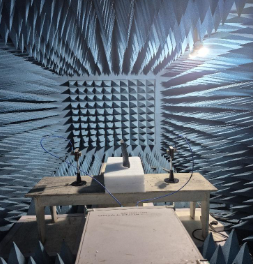
The anechoic chamber facility at IPR has been expanded for collaborative use by industries and academic institutions for advanced RF and plasma diagnostics. The chamber, equipped with a Vector Network Analyzer (VNA), antennas, and precision measurement instruments, supports free-space electromagnetic characterization across the 1–18 GHz frequency range.
Key capabilities include transmission and reflection measurements, Radar Cross Section (RCS) analysis, and plasma parameter studies. The facility operates under stringent electromagnetic safety protocols and has successfully supported testing of multiple industrial and academic samples, accelerating research and development activities in plasma and RF engineering.