

The PDTSD division primarily works in the areas of fundamental plasma simulations, plasma device simulations, and tokamak simulations. Several simulation codes have been developed in-house from scratch to study fundamental plasma phenomena and to model plasma devices. A brief overview of these codes is provided below:
(a) Code namely PEC2PIC and PEC3PIC for toroidal magnetically trapped plasma simulation.
(b) Three dimensional Pseudo spectral magnetohydrodynamic GPU code for astrophysical plasma simulation.
(c) Two dimensional and three dimensional molecular dynamics code (MPMD 2.0, MPMP 3.0, both active and passive) for fundamental plasma and active matter simulation.
(d) A one dimensional Vlasov code (VPPM solver) is developed to study wave-particle interaction and several plasma instabilities.
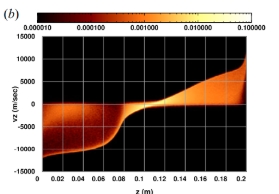
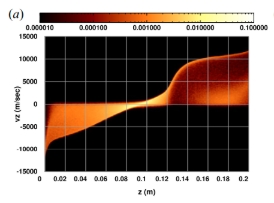
(e) 1D3V and 2D3V PIC-MCC code (EPPIC1D and EPPIC2D) is developed for expanding magnetic field plasma simulation.
Apart from this, the division is involved in the following areas:
Numerical simulation and analytic studies of sheared flow effects on classical and neoclassical tearing modes. Nonlinear simulation of ELM dynamics in the presence of RMPs, pellets, and flows. Simulation of the internal kink mode in visco-resistive regimes with flows. Full 3D MHD simulation for Aditya-U tokamak using the JOREK code.
Plasma Devices Theory & Simulation
Overview
Plasma Devices Theory & Simulation
Activities
1. Majorly involved (a) To simulate using gyro kinetic model and understand hot fusion plasma transport in the core of a Tokamak plasma. Transport due to Ion Temperature Gradient (ITG) modes, Trapped Electron Mode (TEM), coupled ITG-TEM, short-wavelength ITG (SWITG), Electron Temperature Gradient mode (ETG), Coupled ETG-TEM mode, nonperturbative fast particle stabilization of finite beta−ITG, effect of v_parallel -nonlinearity on ITG turbulence, Spectral properties of ITG turbulence and coherent structures, turbulence in SWITG, Global Toroidal Universal Drift Instability.
(b) Using PEC2PIC, the physics of confinement of pure electrons or pure ions in a magnetized straight cylinder. Effect of increased density for a given applied magnetic field strength, effect of weak charge neutralization by adding a small fraction of oppositely charged particles and the effect of collisions by Monte Carlo Collision method (MCC).
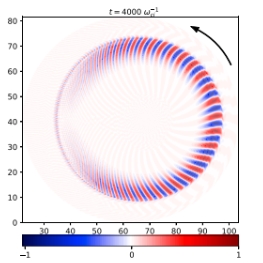
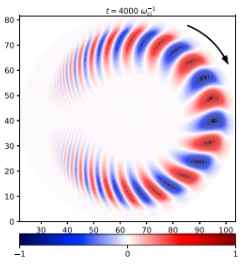
(c) Several interesting areas explored using the MPMP code. For example, Melting of a Yukawa solid near the solid liquid phase boundary in the presence of a weak external compressional electric field, linear and nonlinear Kelvin-Helmholtz instability in strongly coupled Yukawa liquids, Dipolar Vortex structures in Yukawa liquids are some examples.
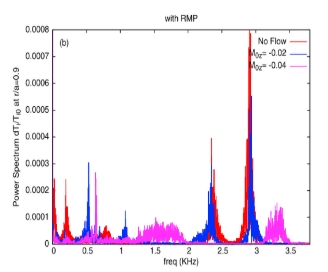
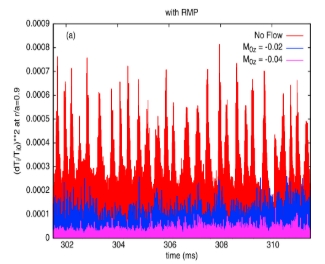
2. Conducted numerical simulations and analytical investigations of the effects of sheared plasma flows on classical and neoclassical tearing modes. Performed nonlinear simulations of edge-localized mode (ELM) dynamics in the presence of resonant magnetic perturbations (RMPs), pellet injection, and plasma flows. Simulated the internal kink mode in visco-resistive plasma regimes, incorporating the effects of plasma flows.
Figure: Showing the Influence of off-axis negative flows on the amplitudes of ELMs for two different strengths of the flow shear. (b)Power spectra of the ELMs for the corresponding flows.
3. Developed 1D3V and 2D3V Particle-in-Cell Monte Carlo Collision (PIC-MCC) codes for the simulation of expanding magnetic field plasma thrusters. These solvers were used to investigate thrust generation mechanisms. Furthermore, studies on a bi-directional plasma thruster demonstrated its potential for both propulsion and active space debris removal.
In addition to plasma thruster simulations, performed 3D nonlinear magnetohydrodynamic (MHD) simulations for the Aditya-U tokamak using the JOREK code. Investigated the rotation of drift tearing modes, the evolution of magnetic island width, and the influence of resistive walls on drift tearing mode dynamics.
Division Head

Team Members