1. Discharge Modelling of Tokamak for Loop Voltage Optimization and Error-Field Reduction
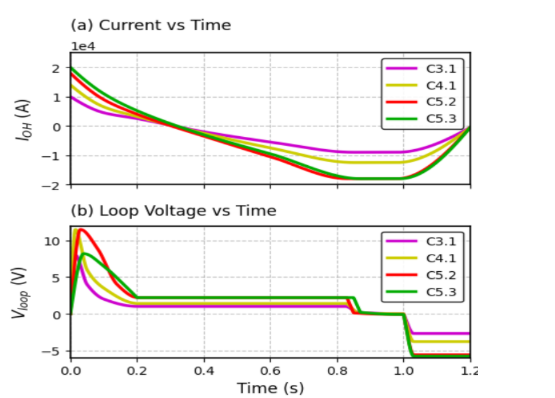
In tokamak circular plasma operations, successful plasma startup hinges on providing a sufficient inductive loop voltage to initiate the Townsend avalanche. During the early breakdown phase, rapidly discharging the current in the Ohmic Heating coils creates a robust inductive electric field. As shown in the discharge trajectories, a higher initial flux swing—driven by optimizing the pre-bias current across scenarios like C5.2—yields a sharp, prominent loop voltage spike exceeding ten volts. This strong parallel electric field provides the necessary acceleration to seed electrons, ensuring rapid ionization of the neutral gas while transitioning into a stable, controlled plateau to sustain early current ramp-up.
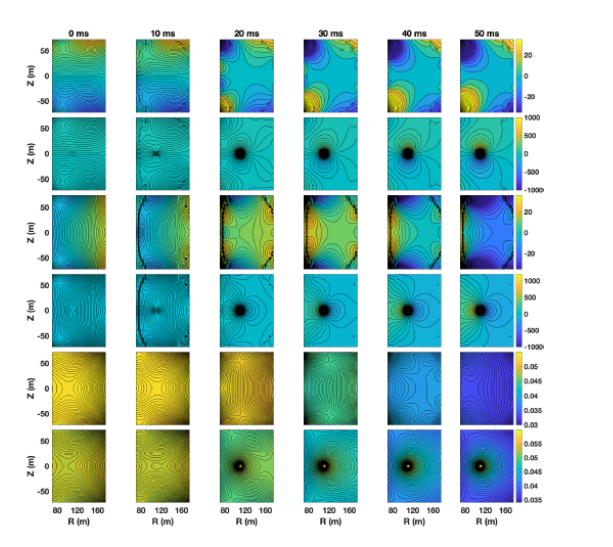
Simultaneously, establishing an optimal magnetic null configuration is critical to prevent premature particle loss before the plasma forms closed magnetic surfaces. Stray error fields, arising from coil misalignments and eddy currents induced in the passive vacuum vessel structures, can degrade this null zone by forcing accelerating electrons into the vessel walls. As illustrated in the spatial magnetic field contour profiles, the magnetic field topology must be carefully tuned to minimize these error fields below a critical threshold (typically twenty Gauss or less). Precise error-field minimization expands the volume and duration of this low-field region, drastically increasing the connection length of the open magnetic field lines. This optimized magnetic environment confines trailing electrons long enough to maximize ionization efficiency, ensuring a reliable burn-through phase and a clean startup.
2. Plasma Breakdown and Start-up Modelling in a Tokamak
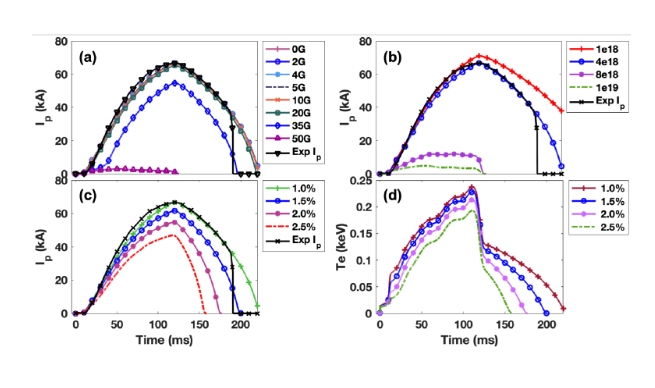
The figure shows the fundamental time evolution of a tokamak plasma during breakdown and startup, where a weak neutral gas is transformed into a hot, conducting plasma under the action of an applied loop voltage. Initially, the electric field accelerates seed electrons, which collide with neutral atoms and produce further ionization, leading to an avalanche process. This is reflected in the rapid rise of plasma current and electron density during the early phase. As ionization progresses, the loop voltage begins to drop because the plasma becomes more conductive and the effective resistive impedance decreases. Electron temperature increases due to Ohmic heating and auxiliary energy input, while ion temperature rises more slowly through collisional energy exchange with electrons. Neutral density decreases sharply as atoms are ionized and exhausted, marking the transition from gas breakdown to a fully ionized plasma state. The effective charge gradually increases as impurities from the vessel walls become ionized and contribute to radiation losses.
After breakdown, the system enters a quasi-equilibrium startup regime where competing processes—Ohmic heating, radiation, transport losses, and particle recycling—determine the evolution of plasma parameters. Radiation and collisional losses limit temperature growth, while plasma current ramps up until resistive and inductive balances are achieved. This coupled evolution is critical in fusion devices because successful startup determines whether the discharge transitions into a stable operating plasma or terminates prematurely. Understanding these dynamics allows better control of voltage programming, gas fueling, and magnetic field settings, which are essential for reliable operation of present and future tokamaks like ITER and DEMO.
3. Plasma Position Control in a Tokamak
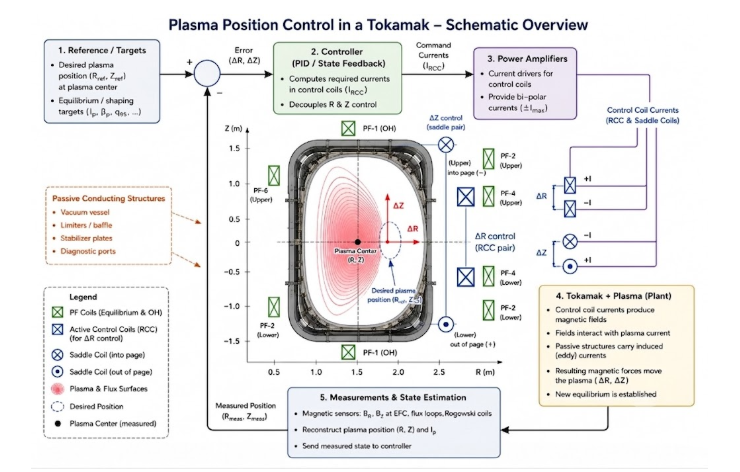
Plasma position control is one of the most important functions in a tokamak, a device that uses magnetic fields to confine extremely hot plasma for fusion research. Because the plasma carries a large electric current and behaves like a dynamic fluid, it naturally tends to move and deform during operation. Even small radial (ΔR) or vertical (ΔZ) displacements can cause the plasma to approach the vessel walls, leading to increased heat loads, electromagnetic stresses, reduced performance, or even a complete disruption of the discharge. For this reason, the plasma position must be continuously monitored and actively controlled throughout the experiment. Magnetic sensors placed around the tokamak measure the plasma location and magnetic field distribution, while dedicated feedback systems compare these measurements with the desired target position.
The control system then commands special magnetic coils to generate corrective magnetic fields that steer the plasma back toward its reference location. Radial Control Coils (RCCs) primarily correct inward or outward motion, while saddle coils are often used to control vertical displacement. These control fields interact not only with the plasma current but also with currents induced in surrounding conducting structures such as the vacuum vessel and stabilizing plates. Since these interactions are highly coupled and occur on very short time scales, mathematical models are used to predict plasma motion and determine the required control actions. Modern feedback controllers repeatedly perform this measurement–prediction–correction cycle many times per second, maintaining plasma stability, protecting machine components, and enabling reliable operation. Effective position control is therefore a fundamental requirement for achieving sustained and efficient fusion plasmas in present-day tokamaks and future fusion power plants.
4. Plasma Equilibrium and Transport
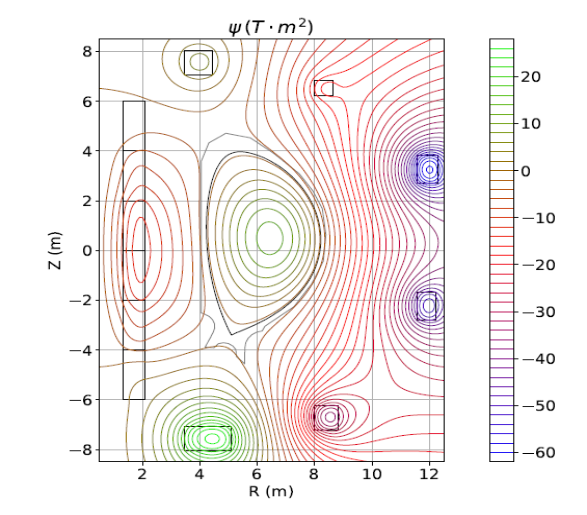
This research focuses on the computation, simulation, and predictive modeling of magnetically confined fusion plasmas, specifically targeting Tokamak equilibrium, stability, and transport. The work integrates theoretical modeling, numerical simulations, and machine learning to address critical challenges in fusion physics.
Key contributions include developing original computational tools: pyIPREQ (free-boundary) and pyVMOMS (fixed-boundary) for equilibrium reconstruction and large-scale plasma analysis. Additionally, the study establishes frameworks for 1.5D transport simulations and alpha-particle heating to evaluate energy confinement in burning plasma scenarios. Charged-particle dynamics and confinement are further analyzed using particle orbit modeling. To enable real-time applications, deep learning surrogate models are implemented to rapidly predict Tokamak equilibrium properties and plasma profiles. By merging physics-based code development with artificial intelligence, this research advances the predictive capabilities required for current and future Tokamak devices.
5. Plasma Heating and Current Drive
The research involves numerical studies on Electron Cyclotron Resonance Heating and Current Drive (ECRH/ECCD) for the tokamak plasma using the ray tracing code GENRAY. The work focuses on understanding wave propagation, resonance behavior, and power deposition for a given tokamak equilibrium profile.
ECRH modeling and simulation are implemented using realistic plasma parameters provided by the EQDSK file, allowing for the study of Ordinary (O) and Extraordinary (X) mode propagation. The analysis further evaluates power deposition profiles across different density and temperature profiles to achieve optimum power absorption. Additionally, a Python-based automation tool generates various input files for GENRAY and runs the executable to optimize both on-axis and off-axis heating conditions.