Open House Help Desk Public Grievances IPR Act and Rule
Opportunities Annual Reports Tender Dashboard

Tokamak Fuelling and Exhaust Handling

Tokamak Fuelling and Exhaust Handling
Overview

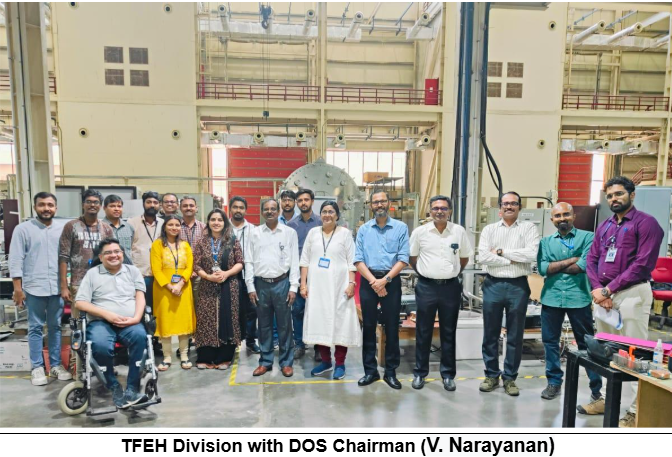
Tokamak Fuelling and Exhaust Handling (TFEH) Division of the Institute for Plasma Research (IPR) plays a key role in developing technologies for fuelling and exhaust for devices with magnetically confined plasma in fusion devices. As part of IPR's indigenous cryopump development programme, the Division has successfully developed liquid helium bath-type cryosorption cryopumps with hydrogen and helium pumping speeds ranging from 2,000 to 50,000 L/s, establishing strong in-house capabilities in large-scale vacuum technology. The division has also developed Pellet Injector for tokamAK (PINAK) for fuelling plasma studies in tokamaks.

Among its notable achievements is the development of the AGASTYA (A GAS Trapping YAntra) liquid nitrogen-based cryopump for SAC–ISRO, with successful technology transfer to industry for commercialization. The Division has patents in con liquid nitrogen bath based vacuum pump and low-temperature emissivity measurement techniques. Current research focuses on developing closed cycle refrigertot based cryopumps, extruder-type pellet injectors, fusion-grade cryogenic adhesives, and diagnostics for pellet mass measurement, further strengthening India's indigenous capabilities in technologies related to fusion engineering.

The Division has established state-of-the-art experimental facilities, including the Large Cryopump Test Facility (LCTF), cryogenic thermal conductivity measurement systems operating below 10 K, material outgassing characterization facilities, and adsorption isotherm measurement systems for sorbent materials down to 4 K.
Tokamak Fuelling and Exhaust Handling
Experiments

1.Large Cryopump Test Facility (LCTF)

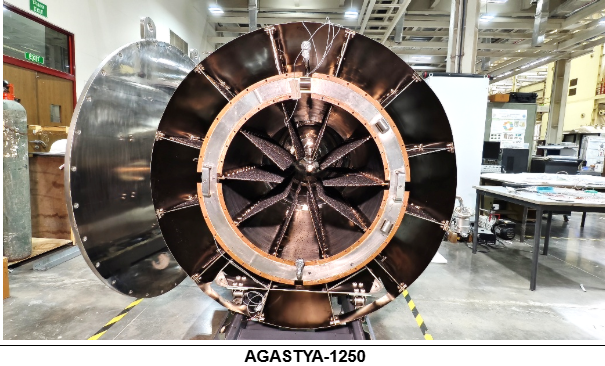
The Large Cryopump Test Facility (LCTF) is a dedicated infrastructure for the design validation, performance evaluation, and qualification of large-capacity cryopumps for fusion, space, accelerator, and other high-vacuum applications. The facility supports standardized testing of liquid nitrogen-cooled cryopumps in accordance with American Vacuum Society (AVS) standards. A 1250 mm diameter LN₂-cooled sorption cryopump has been successfully designed, fabricated, and qualified. The facility can also accommodate liquid helium-cooled and cryocooler-based cryopumps of suitable dimensions for comprehensive pumping performance characterization.


2.Liquid nitrogen cooled sorption pump (AGASTYA-400)

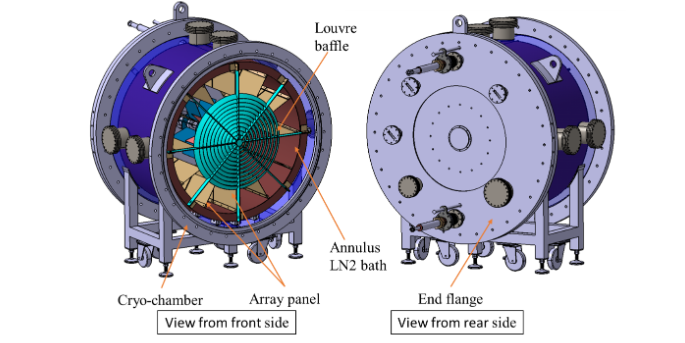
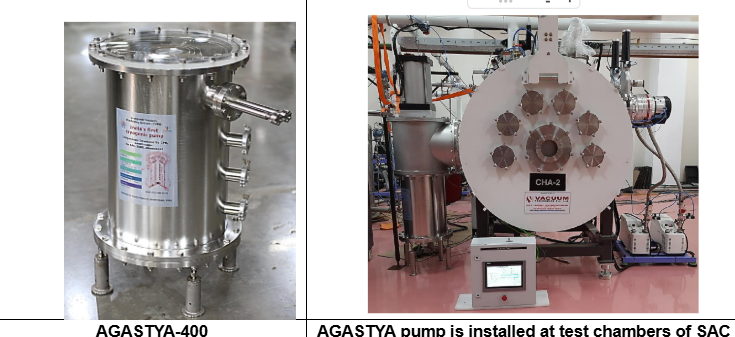
A MoU was signed between IPR and SAC, ISRO for supply of three liquid nitrogen based 400 mm opening cryopump branded as AGASTYA-400 (A GAS TRAPPING YANTRA). The pumps are installed on environmental test chambers at SAC ISRO, Bopal and are working fine since past 4 years. AGASTYA has a liquid nitrogen bath at its centre and the cryopanels are coated with coconut shell charcoal which get cooled by conduction as they are mounted on the bath. It differs from the existing commercial cryopumps in a way that it does not require any compressor, hence has no vibration, and customizable. It provides pumping speed of ~4000 l/s for Nitrogen and about ~16000 l/s for water vapor with an experimentally tested pumping capacity of > 6000 mbar-l.


3.80 K Large Size Cryopump (AGASTYA-1250)

Liquid nitrogen-cooled large-size cryopumps are emerging as a superior, high-speed solution. In pursuit of this objective, IPR has developed the Large Cryopump Test Facility (LCTF) for fusion scale cryopump development and testing. For the technical cooperation and capacity building, a MoU is signed between IPR and SAC-ISRO and as a deliverable IPR has supplied AGASTYA-1250 to SAC-ISRO. The main operating function of this cryopump is to achieve pumping speed of 1,50,000 l/s (+/- 10%) for water vapour and 45,000 l/s (+/- 10%) Air/N2 using liquid nitrogen as a cooling medium. The system must cool down within 3 hours and should reach a base vacuum pressure of ≤ 5E-7 mbar.


4.Pellet Injector for Tokamak (PINAK)

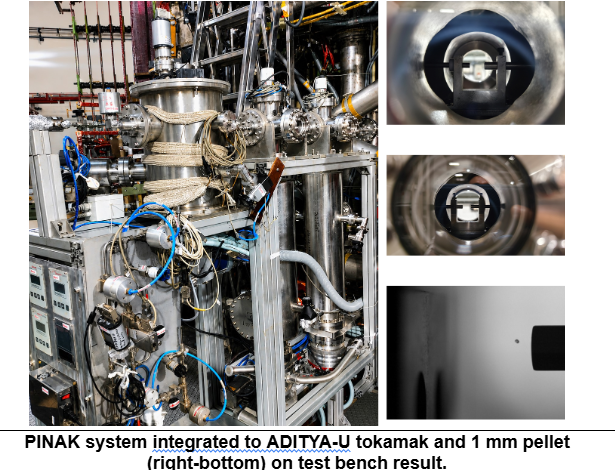
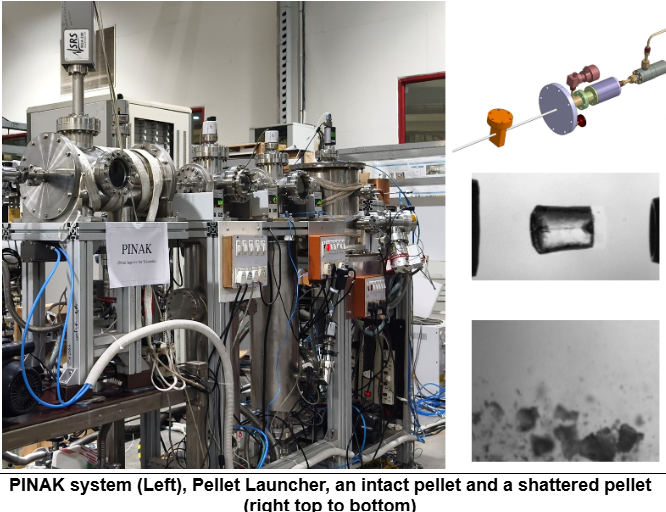
Pellet injector system for plasma fueling and control in tokamak: Fueling and plasma control are two important aspects in successful operation of a fusion device. As a part of the ongoing technology development program, a Pellet Injector for tokamak (PINAK) plasma application has been developed for producing solid hydrogen pellets. Pellets of different size ranging from 0.8 mm to 6 mm (cylindrical shape) and speed 100 to 1000 m/s were successfully achieved for fueling as well as plasma control study. The injector is also capable of freezing Argon pellets having application to disruption mitigation study in tokamak.

Division Head

Dr. Ranjana Gangradey

Dr. Ranjana Gangradey

Designation
:
Scientific Officer-H
Phone
:

Team Members

Samiran Mukherjee

Samiran Mukherjee

Designation
:
Scientific Officer-F
Phone
:
Dr. Jyoti Shankar Mishra

Dr. Jyoti Shankar Mishra

Designation
:
Scientific Officer-E
Phone
:
Vishal Gupta

Vishal Gupta

Designation
:
Scientific Officer-E
Phone
:
Pratikkumar A Nayak

Pratikkumar A Nayak

Designation
:
Technical Officer – C
Phone
:
Shubham Upadhyay

Shubham Upadhyay

Designation
:
Scientific Offier-C
Phone
:
Paresh M. Panchal

Paresh M. Panchal

Designation
:
Scientific Assistant-D1
Phone
:
Hemang S Agravat

Hemang S Agravat

Designation
:
Scientific Assistant - D1
Phone
:
Moni Banaudha

Moni Banaudha

Designation
:
Scientific Assistant-D1
Phone
:
Last Updated: 17-Jul-2026 03:50 PM